
|
Free school meals and teacher turnover The recent publication of the new data dashboard from the National Foundation for Educational Research (NFER) sheds further light on teacher retention and attrition issues; an issue which, as the sector is painfully aware, continues to move in an unfavourable direction. The data has been organised by geography (including by local authority), main teaching subject, and free school meal eligibility; the last of which has demonstrated some striking correlations. The data has been organised into quintiles (fifths) by the proportion of pupils in each school who are eligible for free school meals (FSM). The following findings in particular display the challenging context that some school leaders and MATs are facing:
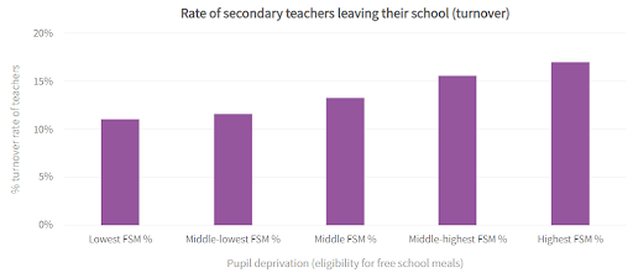 Not only does higher turnover have the potential to negatively impact the learning experience of students (see Second Time's the Charm? How Sustained Relationships from Repeat Student-Teacher Matches Build Academic and Behavioral Skills (edworkingpapers.com) for an interesting paper on “looping”, i.e. having the same teacher for more than one year), but there are associated costs, such as advertising and recruitment. There are also broader pastoral issues to consider, such as relationships with students, parents and carers, and the local community.
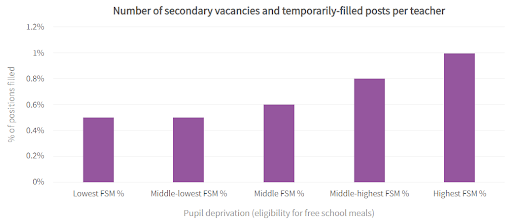 A high turnover of staff is exacerbated when recruitment is harder and schools may have to rely on temporary contracts. This is a problem typically associated with smaller, rural settings, particularly the most isolated. However, it also appears to be affected by the amount of deprivation within the cohort; and all of this leads to a hidden cost which is very pronounced…
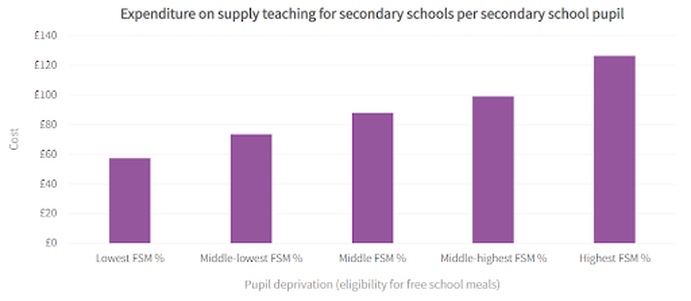 The costings for the year shown above (2020) are as follows: from left to right £58, £74, £88, £99 and £127 per pupil.
That is a difference of £69 per pupil between the lowest and highest quintiles; a gap which is larger than the entire cost per head of the lowest quintile. Many leaders and trustees may be aware of the high costs that schools are spending on supply teaching; perhaps not as many are aware of the link to the deprivation level of their cohort. This blog started with a simple set of data which shows that teacher turnover rates are not evenly distributed across schools. As a sector, we need to recognise this fact, and consider the motivations that may underpin the patterns. It should also be considered at a national level, particularly in terms of funding. In terms of motivation, my initial response would be that higher levels of deprivation result in more challenging behaviour, as measured by suspensions and exclusions across our system. Such behaviours increase workload and stress for staff working in such settings, making supportive leadership, policies and processes even more vital for staff retention. Additionally, my own teaching experience tells me that the most vulnerable students need the most stable and caring relationships; something which may be harder to foster with temporary teachers and higher turnover. Unfortunately, it feels like a situation in which ground can be lost. School leaders and managers may want to continue their focus on staff support by prioritising wellbeing and focusing on the creation and implementation of systems that enable them and their learners to thrive. Where staff feel valued and able to manage a healthy work-life balance, they are more likely to work positively and collaboratively over a longer period toward the vision of the school leadership - and to stay long term in the profession. Kat Stern Link to the dashboard: Explore by school type - NFER
0 Comments
Leave a Reply. |
Privacy policy
This privacy policy sets out how Expecto Patronum Consultancy uses and protects your information.
1. Collection of information
1.1 Data can be collected and processed during your visit to this website. The following are ways in which this may be collected:
(a) Data regarding your visit(s) to this website and any resources used, which may include but is not limited to: location data, traffic data, and any other communication information.
(b) Data contained in any forms you fill out on our website.
(c) Data collected when you communicate with our staff or our website. Any request you make via our website or to our personnel allows us to use information you have provided us with, relating to the products or services related to EP Consultancy.
1.2 Any data shared online is not completely secure and Expecto Patronum Consultancy cannot guarantee full protection or security, only that we will take all reasonable action to protect information that is shared with us electronically. Sharing such data is at your own risk. Where your information relates to services provided by Expecto Patronum Consultancy, it will be kept for a period of up to five years after your account is closed.
1.3 As per the Data Protection Act 1998, you have access to any of your data or information that we hold in relation to you. If you wish for this information to be released to you, there is a £5.00 administration fee prior to the data release. Please use the email address listed on the website if you wish to request your data.
2. Sharing information
2.1 Expecto Patronum Consultancy will not sell, rent, or share your personal data with any third party for marketing purposes.
3. Marketing Communications
3.1 Expecto Patronum Consultancy may send information regarding products or services that you may be interested in.
3.2 Should you not wish to receive these, an unsubscribe option is attached to these communications, which will prevent you receiving further information regarding products and services. We may still need to contact you for other operational purposes.
4. Third parties
4.1 Where third party links are present on the site, they are responsible for their own privacy policy. Expecto Patronum Consultancy is not responsible for the content or privacy of third party links.
This privacy policy sets out how Expecto Patronum Consultancy uses and protects your information.
1. Collection of information
1.1 Data can be collected and processed during your visit to this website. The following are ways in which this may be collected:
(a) Data regarding your visit(s) to this website and any resources used, which may include but is not limited to: location data, traffic data, and any other communication information.
(b) Data contained in any forms you fill out on our website.
(c) Data collected when you communicate with our staff or our website. Any request you make via our website or to our personnel allows us to use information you have provided us with, relating to the products or services related to EP Consultancy.
1.2 Any data shared online is not completely secure and Expecto Patronum Consultancy cannot guarantee full protection or security, only that we will take all reasonable action to protect information that is shared with us electronically. Sharing such data is at your own risk. Where your information relates to services provided by Expecto Patronum Consultancy, it will be kept for a period of up to five years after your account is closed.
1.3 As per the Data Protection Act 1998, you have access to any of your data or information that we hold in relation to you. If you wish for this information to be released to you, there is a £5.00 administration fee prior to the data release. Please use the email address listed on the website if you wish to request your data.
2. Sharing information
2.1 Expecto Patronum Consultancy will not sell, rent, or share your personal data with any third party for marketing purposes.
3. Marketing Communications
3.1 Expecto Patronum Consultancy may send information regarding products or services that you may be interested in.
3.2 Should you not wish to receive these, an unsubscribe option is attached to these communications, which will prevent you receiving further information regarding products and services. We may still need to contact you for other operational purposes.
4. Third parties
4.1 Where third party links are present on the site, they are responsible for their own privacy policy. Expecto Patronum Consultancy is not responsible for the content or privacy of third party links.
Proudly powered by Weebly